

Triple Cheese avoids classic synthesis techniques—no subtractive, frequency modulation (FM) or additive synthesis. Rather, it employs various types of comb filter, often in series, to generate and modify sound. Think of the comb filters as very short chromatically tuned delays. Three modules are arranged in series and either generate their own sound, or process the output of the previous module.
The features for each module can result in sounds that might seem a little “cheesy” or retro (think early 1980s digital synths). But when pushed, you will find Triple Cheese creates some surprisingly lush sounds.
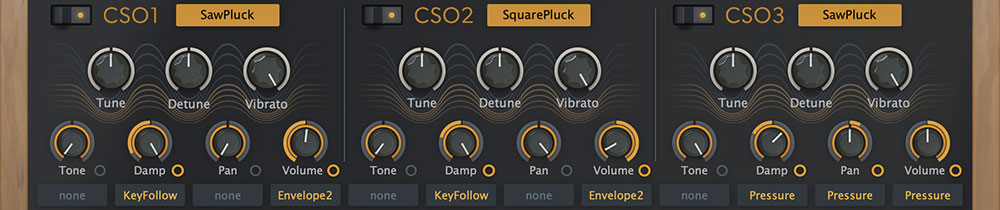
Sound generating comb filter modules
Extra cheese
For extra flavour, Triple Cheese comes with a choice of delay-based effects. Although basic, the essentials are covered: chorus, flanger, phaser, delay, or reverb. A special LFO with speed and depth controls can be used to give your sound extra movement and warmth.
Another way to add flavour: parameter modulation. Many of the key parameters in Triple Cheese can be modulated from a variety of sources: Select one of the classic performance controls (modwheel, velocity, pressure, key follow etc.) or an automatic modulation source (envelope, LFO or Vibrator).
Requirements
Linux
- Host software / DAW
- 1GB RAM, more recommended
- 1000 × 600 or larger display
- 25-85 MB free disk space
- Modern CPU required:
Windows/Linux: Intel Nehalem or newer, AMD Bulldozer or newer
Mac: Intel Nehalem or newer, Apple silicon M1 or newer - Linux: glibc version 2.28 or newer
Formats
Triple Cheese is not a standalone product, it requires host software. Triple Cheese is compatible with nearly all DAWs.
macOS:
- AUv2, VST3, 64-bit only
Windows:
- VST3, AAX*
- 32-/64-bit
* AAX requires Pro Tools 10.3.7 or later
DOWNLOADS:
User Guides